
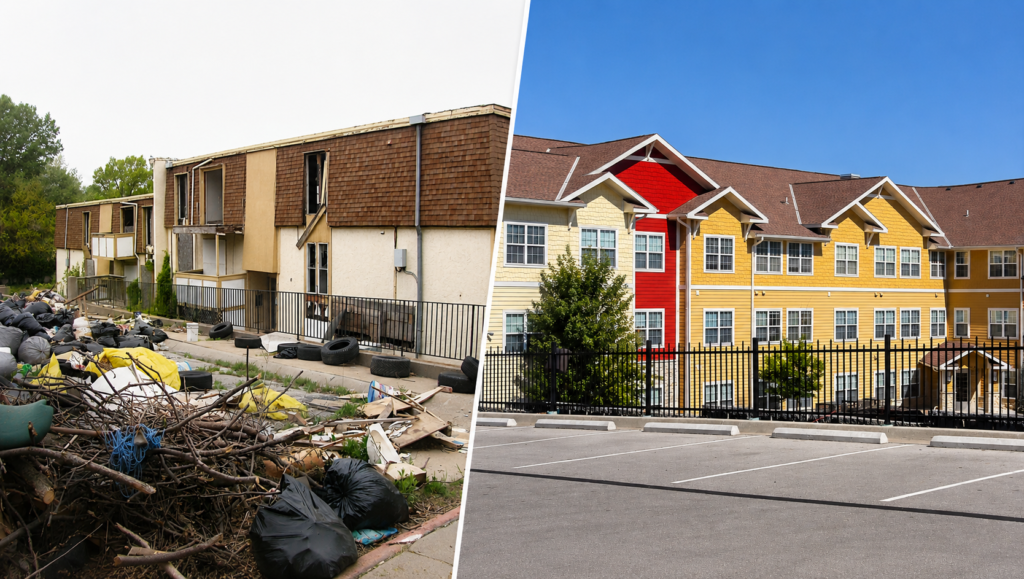
When homes sit vacant for years, the damage spreads far beyond one address. Abandoned properties can weaken a block, create safety concerns and make it harder for neighborhoods to attract the investment they deserve.
Missouri’s Abandoned Housing Act was created to help change that. The law gives qualified nonprofit organizations a legal path to step in when a residential property has been abandoned, becomes a nuisance and shows no realistic sign of being restored by its owner. Through the courts, those groups can pursue rehabilitation and help return the property to productive use.
CBKC Board of Directors Secretary and former Missouri lawmaker Shalonn “Kiki” Curls has helped strengthen that framework over the years. It was her uncle, former senator Phil Curls, who passed the original bill in 1993, and Kiki Curls continued the family’s focus on urban revitalization during her own tenure as a legislator. While in the Missouri House and Senate, she continually sponsored bills aimed at giving communities more tools to stabilize distressed properties and combat blight.
The Abandoned Housing Act’s impact has been tangible in Kansas City. A prime example is the CBKC-owned Cameron Place Apartments, located at 3218 Brighton Ave. next to the Kansas City VA Medical Center. Opened in 2013, the $8.4 million, 48-unit development was created to serve individuals with special needs and includes one-, two- and three-bedroom apartments, a community room, tenant-focused programming and an onsite service coordinator.
“Neighborhood transformation takes vision, investment and strong community partners, but it also requires the right tools,” said Emmet Pierson Jr., president and CEO of Community Builders of Kansas City. “Laws like the Missouri Abandoned Housing Act can help communities move neglected properties from a state of decline to places of stability, dignity and opportunity.”
The original building (formerly known as the Boulevard Village apartments) was a massive, abandoned complex that had become a dangerous building and source of significant blight. Swope Community Builders (now Community Builders of Kansas City) used the Missouri Abandoned Housing Act, along with assistance from the Polsinelli Law Firm and Legal Aid of Western Missouri, to acquire the property from its neglectful owners.
CBKC tore down the derelict structure and built the new, 48-unit apartment building. It stands as a model success story about how the Abondoned Housing Act can be used to convert nuisance properties into affordable housing.
This law creates a path for communities to confront blight instead of living with it. Organizations like CBKC show what is possible when that vision becomes real investment in housing, dignity and neighborhood stability.